Omnichannel AI agents unify every customer touchpoint into one intelligent workflow. In this guide, we explain what they are, how they work and why enterprises use them to cut costs and lift conversion.
Key takeaways:
- One workflow: Omnichannel AI agents unite WhatsApp, Facebook, Instagram, web chat, email and phone into a single, intelligent workflow.
- Less routine work: Enterprises automate 60–70% of routine enquiries, which frees staff and cuts cost per interaction by 40–50%.
- Fast escalation: Dual-channel escalation (chat to voice) resolves complex issues in minutes. It lifts conversion by 30–40% and halves drop-off.
- Revenue insights: AI analytics reveal campaign attribution, hot and cold lead scores and journey drop-offs.
Five years ago, “omnichannel” meant having a presence on several platforms: a website, a Facebook page and maybe a WhatsApp number. Today, it means far more. Customers expect smooth, contextual and intelligent engagement on every channel they choose.
Clearly, expectations have changed. Customers do not care if your WhatsApp team is separate from your call centre. Nor do they care if Facebook messages sit in a different inbox from web chat. They care that when they message you on Tuesday about a booking change, the person they call on Wednesday already knows what they asked.
Why most enterprises fall short
But most enterprises are not built for this. They have:
- Fragmented channels: WhatsApp, Facebook, Instagram, web chat, email and phone all work in silos.
- No shared context: Agents cannot see earlier conversations, so customers repeat themselves.
- Slow escalation: When chat fails, there is no smooth path to a live agent.
- Blind spots: There is no view of which channels convert, where leads drop off or which campaigns work.
As a result, revenue is lost, customers are frustrated and teams drown in repetitive work.
Enter omnichannel AI agents. These systems unify every channel, automate routine work and escalate complex issues smoothly. They also turn engagement data into revenue insights.
This guide explains what omnichannel AI agents are, how they work and why modern enterprises use them to cut costs, boost conversion and future-proof customer engagement.
The business case: four metrics that matter
1. Conversion rate: turning more leads into revenue
After all, every enterprise has a funnel. In hospitality, enquiries become bookings. Retail turns browsing into purchases, while healthcare turns enquiries into appointments. Yet the bottleneck is almost always the same: slow or missed replies to high-intent leads.
Omnichannel AI agents tackle this by:
- Scoring leads by hot or cold intent. For example, a customer asking about pricing and availability is hotter than one asking about returns.
- Tracking drop-offs to see where prospects abandon the journey.
- Nurturing leads with personalised messages at a frequency based on score and behaviour.
- Enabling dual-channel escalation. When a lead shows signs of dropping off, the system can trigger an immediate call from a human agent.
Enterprises using omnichannel AI agents see conversion rise by 30–40% on average. Some industries see even higher gains.
2. Response time: from hours to minutes
Speed matters. Research shows that 55–60% of prospects will turn away from a business that is hard to contact. What’s more, the average customer now expects issues resolved within 30 minutes.
Omnichannel AI agents shorten response times by:
- Automating 60–70% of routine enquiries (pricing, availability, policies, FAQs) in under 30 seconds.
- Routing complex queries to the right agent based on skill, availability and priority.
- Enabling chat-to-call escalation in the same thread, so customers never start over.
The result? Average response times drop from 2–3 hours to 10–15 minutes. Complex issues are resolved in one 3–5 minute conversation instead of bouncing across days.
3. Labour efficiency: freeing 60–70% of staff time
In fact, across industries, 60–70% of daily enquiries are routine. These questions consume a lot of staff time but add little value.
Omnichannel AI agents automate these conversations. As a result, teams can focus on:
- Closing complex deals, such as group bookings, corporate contracts and high-value patient cases.
- Upselling and cross-selling, such as premium packages, add-ons and extended services.
- Strategic work, such as campaign optimisation, retention and process improvement.
For business owners, this means less hiring pressure, a lower cost per interaction and better staff retention.
4. Actionable insights: turning data into revenue
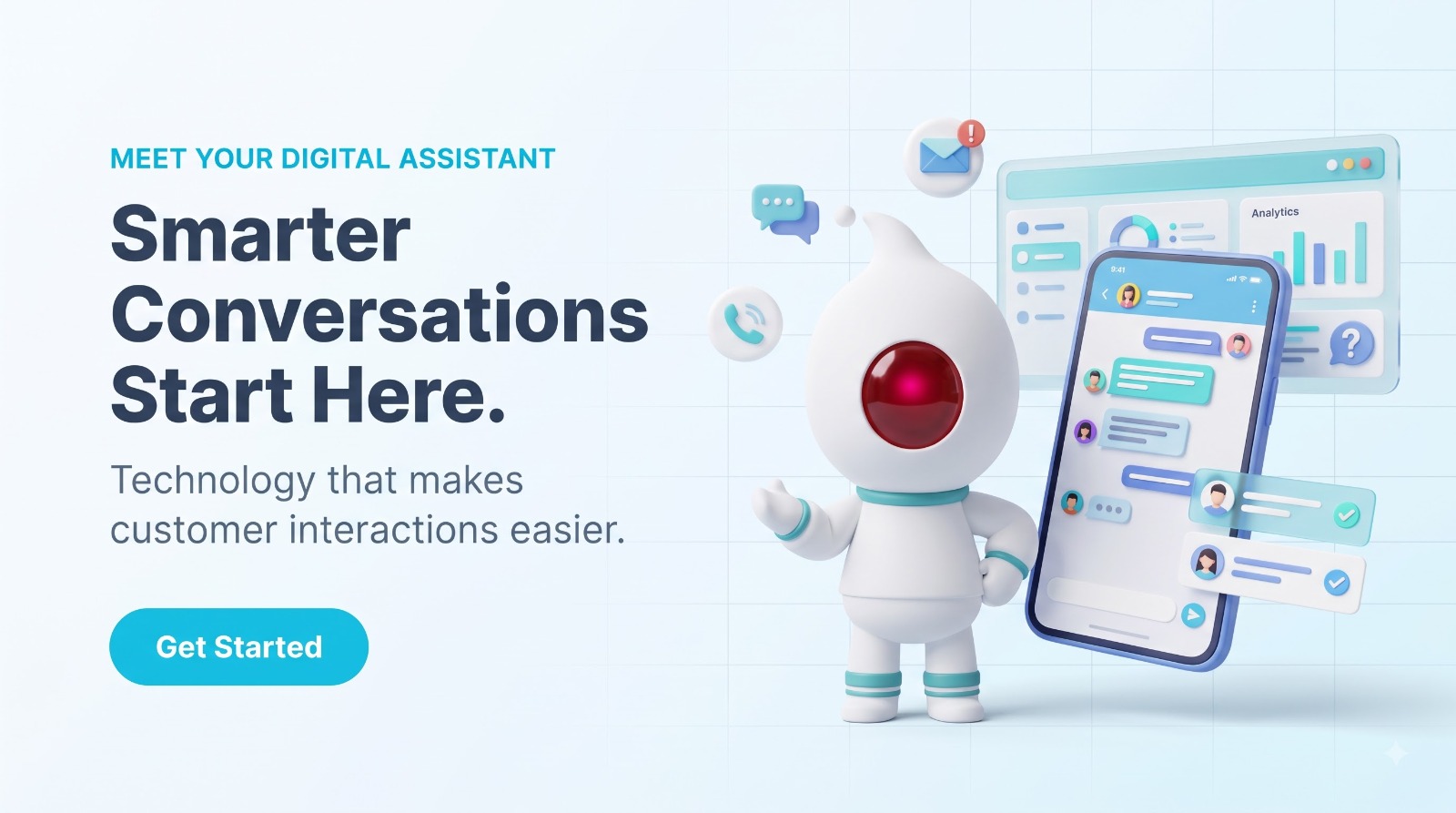
Most enterprises have data, but few have insights. Omnichannel AI agents change that with:
- Campaign attribution: See which channels (WhatsApp, Facebook, web chat, phone) convert best.
- Journey analytics: See where leads drop off and why.
- String queries: Pull insights from existing data, such as “show me all enquiries about cancellations in the last 30 days”.
- Bucketing and scoring: Segment leads by intent, value and likelihood to convert.
For a CTO or operations leader, this means optimising campaigns on logic, not guesswork. For example, you might see that leads who get a follow-up call within 15 minutes of a WhatsApp enquiry convert at 2.5x the rate of email-only leads. With that insight, your team can prioritise high-intent leads. So conversion improves without adding headcount.
How it works: the architecture of an omnichannel AI agent
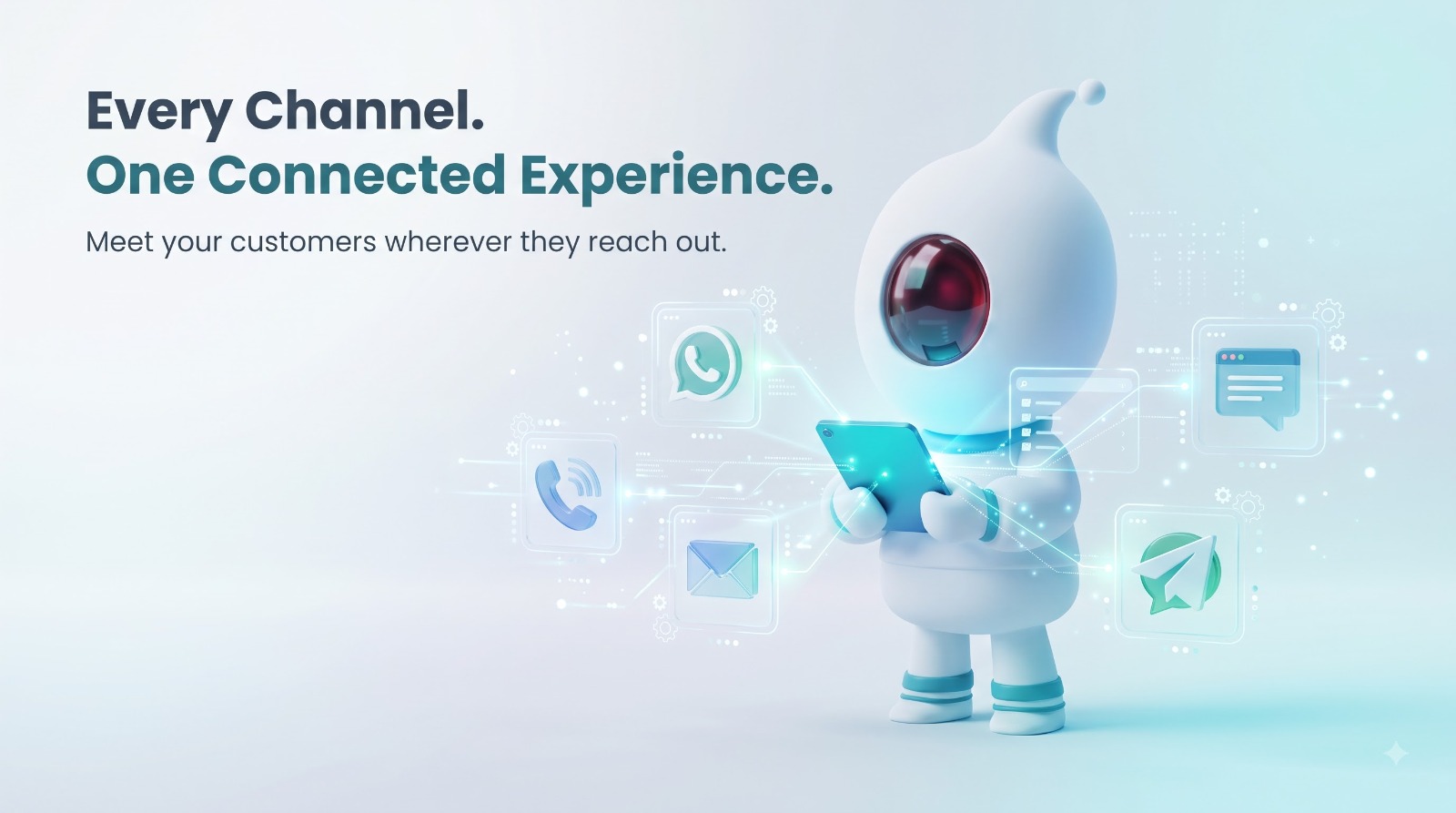
An omnichannel AI agent sits on top of your existing tech stack, such as your CRM, booking engine, EHR or PMS. It unites every customer touchpoint into one intelligent layer. Here is the flow:
- A customer reaches out on any channel (WhatsApp, Facebook, Instagram, web chat, email or phone).
- The AI agent receives the message, understands the intent and checks the customer’s history.
- Routine questions get instant answers from pre-trained knowledge (pricing, policies, availability, FAQs).
- Complex queries get a hot or cold score and go to the right agent.
- If escalation is needed, the customer sees a “Call Now” option right in the chat.
- The agent receives full context (chat history, metadata, earlier conversations) before engaging.
- The whole interaction is logged under one conversation record for future reference and analytics.
As a result, no enquiry falls through the cracks and no customer repeats themselves. Equally, no high-intent lead is left waiting. For a closer look at why this beats scripted bots, read AI agents vs. chatbots.
Case study: a multi-location retailer cuts response times by 90% and lifts conversion by 35%
Company: A 25-store home goods and furniture chain across Australia.
Challenge: Enquiries arrived via Facebook, Instagram, WhatsApp and web chat, but each channel was managed separately. Responses averaged 3–4 hours. Complex queries about custom orders, delivery timelines and financing took 24–48 hours. The chain estimated it lost 15–20 sales a week across all stores.
Solution: The retailer deployed a BotSpice omnichannel AI agent with dual-channel (chat and voice) escalation and unified analytics.
Results in 60 days:
- AI handled 68% of routine questions instantly, covering store hours, stock, delivery zones and returns.
- Average response time fell from 3.5 hours to 18 minutes across all channels.
- Enquiry conversion rose from 2.1% to 2.8%, a 35% improvement.
- Staff time on routine questions fell by 65%, so store teams could focus on in-person sales and custom orders.
- Recovered revenue reached about $18,000 AUD a month from previously lost sales.
The turning point: A customer asked on Instagram about a custom sofa with a 6-week delivery time. Under the old model, this would have taken 24–48 hours. This time, the AI agent flagged it as a hot lead and offered an immediate call. The store manager saw the full chat history and understood the request in 30 seconds. The order was confirmed in a 5-minute call, worth $4,200 AUD.
The technology: plug-and-play, not a multi-year IT project
For CTOs and operations leaders, the question is not whether this works. Instead, it is whether you can implement it without disrupting existing systems.
Omnichannel AI agents are built for fast, plug-and-play deployment:
- Pre-built integrations with common CRMs, booking engines, EHR systems and PMS platforms keep custom development low.
- GDPR and regional IT security compliance is built in from day one.
- Custom workflows let you define how enquiries are scored, bucketed and routed.
- Minimal dev time: Most enterprises go live within 2–4 weeks.
In other words, you are not rebuilding your tech stack. Rather, you are adding an intelligent communication layer that makes your existing systems work harder. See how this plays out across sectors in how BotSpice agentic AI helps modern enterprises.
The bottom line: a strategic lever, not just a tool
For business owners, the value of omnichannel AI agents goes beyond automation. It is about transformation. Your communication layer shifts from a reactive cost centre to a proactive revenue driver. It gives you:
- Faster responses, which reduce lost leads and lift conversion.
- Labour efficiency, which frees 60–70% of staff time for high-value work.
- AI insights, which show where you win and where revenue leaks.
- Dual-channel orchestration, which gives customers their preferred channel while you keep control.
Meanwhile, customer expectations are rising and labour costs are climbing. So omnichannel AI agents are not a nice-to-have. They are a competitive necessity.
Ready to see what omnichannel AI can do for your enterprise?
Curious how an omnichannel AI agent would fit your workflows, enquiry volumes and tech stack? We can show you.
Book a free demo to see the platform in action and get a tailored ROI assessment. We will walk you through:
- How your current channels map to one omnichannel workflow.
- Where automation can cut staff load straight away without hurting quality.
- What revenue uplift to expect for your industry and scale.
No obligation and no pressure. Just a clear view of what is possible when engagement becomes a strategic advantage.