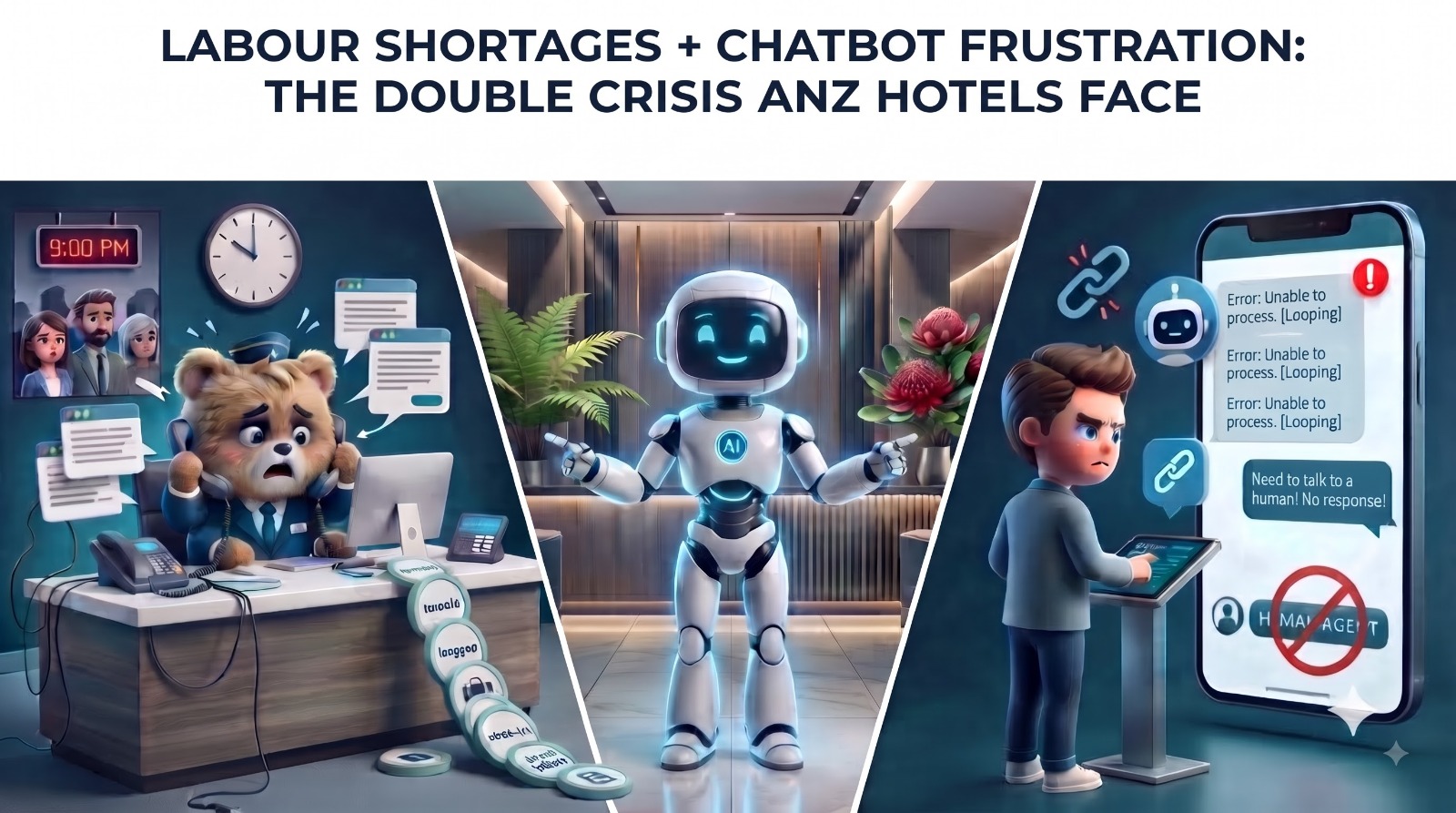
ANZ hotels face labour shortages and chatbot frustration at the same time. Discover how dual-channel chat and calling cuts costs, lifts conversion and turns guest communication into a revenue driver.
Key takeaways:
- A compounding problem: Labour shortages and chatbot frustration feed each other. So tackling them together unlocks outsized value.
- Dead-end bots lose bookings: ANZ guests are 3x more likely to reject dead-end chatbots than Asian guests, so chat-only models actively lose bookings.
- Dual-channel works: Chat plus voice, with omnichannel unification, automates 60–70% of routine queries and keeps human escalation for complex issues.
- From cost to revenue: Hot and cold lead scoring and drop-off tracking turn communication from a cost centre into a revenue engine.
- Plug-and-play: Deployment needs little dev time, meets GDPR and ANZ IT security rules and leaves your PMS and booking systems untouched.
- Real impact: Hotels see response times drop from hours to minutes, conversion climb 30–40% and $8k–$10k a month in lost revenue recovered.
If you run a hotel, resort or managed property portfolio in Australia or New Zealand, you face two relentless pressures. Yet they rarely appear together in the same boardroom discussion.
Two pressures, one compounding problem
The first is the well-documented labour shortage. Across ANZ hospitality, staffing gaps have moved from a “seasonal challenge” to a “structural constraint”. Front desk teams are stretched thin, and reservations roles are hard to fill. Meanwhile, the cost of every extra hire keeps climbing.
The second is guest frustration with digital self-service. Guests will no longer put up with dead-end chatbots, slow email replies and scattered communication across channels.
On their own, each issue erodes margins. However, together, they compound. You pay more for labour while losing revenue, because your communication does not meet modern guest expectations.
This article breaks down the real cost of that double crisis. It then explains how a dual-channel model, combining chat, voice calling and omnichannel support, can solve both problems at once.
The labour reality: it is about cost per interaction, not just headcount
In New Zealand, hospitality operators consistently name labour shortages as their biggest operational pain point. Across Asia Pacific, 87% of hotels expect higher wage costs in the coming year. Competition for skilled staff and the need for premium pay to retain talent drive this. Meanwhile, in Australia, observers describe hospitality labour shortages as at or near record levels.
Most management teams respond by trying to hire more people. However, that approach has three hidden costs that rarely get modelled properly:
- Wage inflation: Every new hire costs more per hour than the person they replace.
- Training and ramp-up: A new reservations agent takes weeks to become fully productive.
- Management overhead: More staff means more complex rosters and more time on HR instead of revenue work.
As a result, your cost per guest interaction keeps rising, while your ability to give fast, high-quality replies stalls.
The chatbot backlash: why self-service is backfiring in ANZ
A few years ago, the industry story was simple. Deploy a chatbot, automate routine questions, cut labour costs and delight guests. In ANZ, however, it has created a new set of problems.
Research shows that ANZ consumers are nearly three times more likely than consumers in Japan or South Korea to be upset by a chatbot that will not connect them to a live agent. The top frustrations are consistent:
- Not being able to reach a live agent from the chatbot (the number one complaint).
- Having to repeat themselves when moved from bot to human.
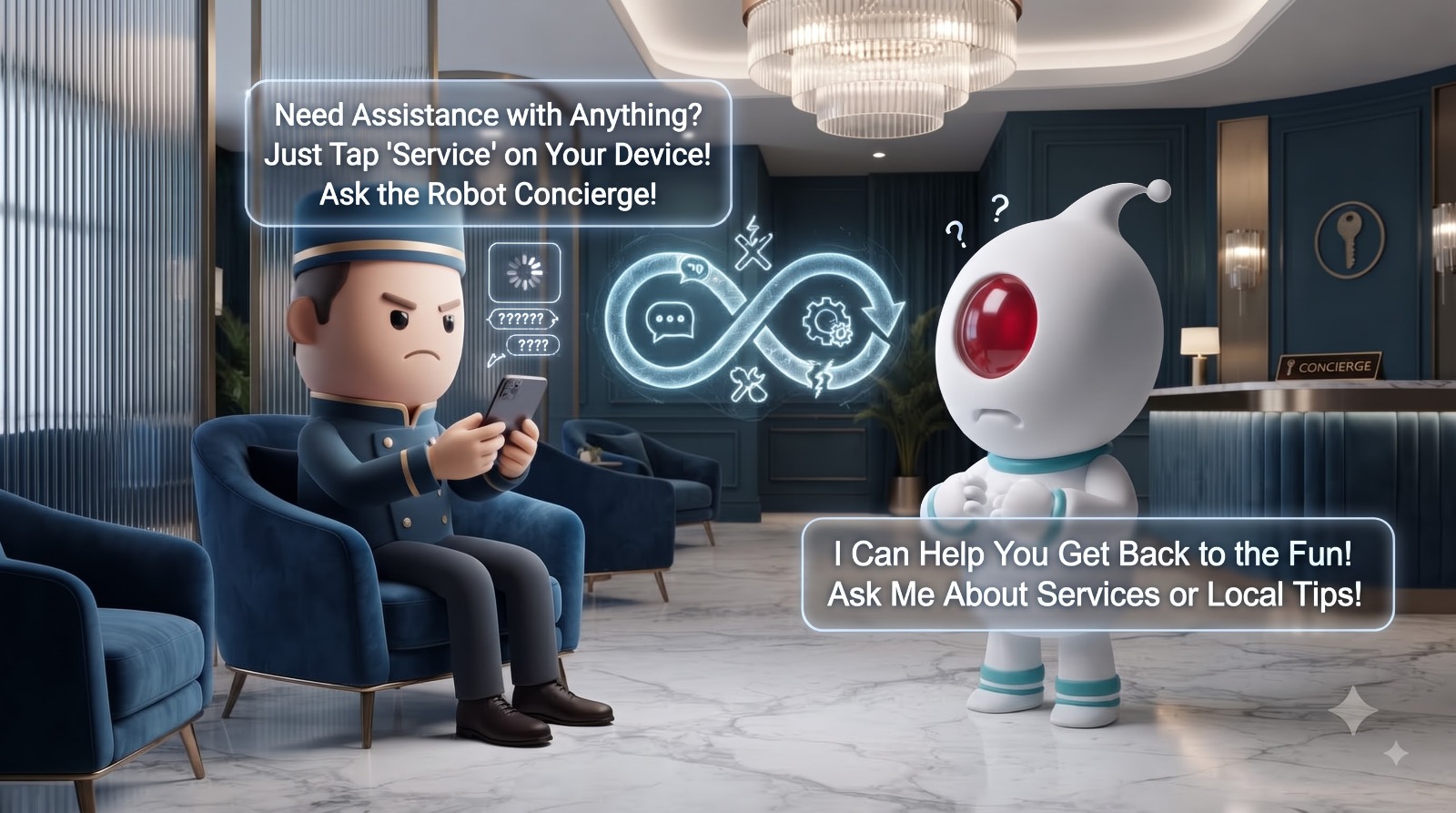
- Getting stuck in loops where the bot cannot solve the issue but will not escalate either.
- Never getting the issue resolved at all.
The outcome is predictable. Only about 20% of consumers find chatbots “extremely satisfying”. Roughly 40% actively avoid AI chatbots, believing they will not understand or help.
For hoteliers, this is lose-lose. You invested in a chatbot to ease the labour load. Yet guests are frustrated, enquiry conversion drops and staff still chase the complex queries the bot could not handle. (For a deeper comparison, see AI agents vs. chatbots.)
The hidden cost: where the two crises collide
This is where the two crises meet in a way that hits your P&L directly.
For example, picture a typical day at a mid-sized ANZ hotel with 50 to 80 rooms and a mix of leisure and business guests. Your front desk and reservations team might handle 40 to 60 enquiries a day. These arrive by phone, email, Facebook Messenger, Instagram DMs, WhatsApp and web chat.
Under a traditional model:
- Routine questions about parking, check-in times, breakfast hours and pet policy take up 60–70% of staff time.
- Complex questions about booking changes, group rates, access needs and late arrivals need human judgement and take longer.
- Enquiries arrive at random across many channels. This creates constant context-switching, so things get missed or delayed.
Now add a chatbot that works in isolation from your phone system, with no smooth path to a live agent. What happens?
- The bot handles some routine questions, but not all, because guests ask things it was never trained on.
- When the bot cannot help, guests either give up or demand a human, often through a different channel.
- Your staff now manage both the bot’s fallout and the original enquiry volume, often without seeing what the guest already tried.
The financial impact shows up in three ways:
- Lost bookings from slow or failed replies. A corporate organiser asking about a 10-room block will not wait 24–48 hours.
- Higher cost per resolved enquiry. Every minute your best staff spend on “Do you have parking?” is a minute not spent closing a group booking.
- Reputational damage from poor service. Guests who cannot get timely answers leave negative reviews, which hurts future occupancy.
This is the double crisis in action. You pay more for labour while losing revenue, because your communication model cannot scale intelligently.
The BotSpice dual-channel solution: chat, calling and omni support as one layer
The way out is not to choose between chat and phone or to throw more people at the problem. Instead, rebuild your guest communication layer so chat, voice and omnichannel support work as one orchestrated system.
This is where a dual-channel model with human L3 dual escalation becomes a strategic advantage. Rather than treating chat and calling as separate silos, you integrate them so that:
- Guests can start with chat for quick questions.
- When things get complex, they can move to a live call in the same thread, without repeating themselves.
- Your staff see the full history, including chat messages, earlier calls and metadata, before they engage. So every conversation is contextual and efficient.
Add omni support, which unites Facebook, Instagram, WhatsApp, Google Business messages and web chat in one workspace. That removes the channel juggling that forces your team across many apps and raises the risk of missed replies. Learn more in our complete guide to omnichannel AI agents.
As a result, the operational benefits are immediate:
- AI automates routine questions, which frees 60–70% of staff time for higher-value work.
- Your team also solves complex queries faster, because the agent has full context from the start.
- Guests use the channel they prefer, without creating chaos on your end.
Turning communication into a revenue driver
Once this dual-channel, omnichannel foundation is in place, guest communication becomes a revenue lever, not just a support function.
This is where campaign attribution, scoring and nurturing come in. Rather than treating every enquiry as a one-off, you can:
- Score leads by hot or cold intent. For example, a guest asking about group rates and flexible cancellation is hotter than one asking about breakfast.
- Track drop-offs to see where prospects abandon the booking process.
- Use AI insights to spot patterns. Are you losing more enquiries at weekends? Do certain room types create complex queries that slow your team?
- Optimise campaigns by adjusting follow-up frequency and channel to match what works for each guest segment.
For example, journey analytics might show that guests who enquire on WhatsApp and get a follow-up call within 15 minutes convert at 2.5x the rate of email-only guests. With that insight, your team can prioritise those high-intent leads. So conversion improves without adding headcount.
A real-world scenario: how this plays out in an ANZ hotel
Scenario: A 65-room Sydney hotel is heading into a busy period. The reservations team is already stretched and fields about 50 enquiries a day across phone, email, Facebook and WhatsApp.
Before dual-channel:
- Staff spend 3–4 hours a day on routine questions like “What time is check-out?” and “Do you have parking?”
- Complex enquiries, such as group bookings, date changes and special requests, take 24–48 hours because staff are constantly interrupted.
- Guests who message on Facebook and get no quick reply often call, which creates duplicate work.
- The hotel estimates it loses 2–3 bookings a week to slow or failed replies, worth about $1,500–$2,000 weekly.
After dual-channel plus omni support:
- The AI bot handles 65% of routine questions instantly, across all channels.
- Complex enquiries get a hot or cold score and go to the right team member.
- Guests can move from chat to call in the same thread, and the agent sees the full history.
- The system also tracks drop-off intent. So if a guest abandons a booking enquiry, they automatically get a follow-up message or call.
Within 60 days, the hotel sees:
- Average response time fall from 2.5 hours to 12 minutes.
- Enquiry conversion rise from 1.8% to 2.6%.
- Staff time on routine questions fall by 70%, so the team can focus on closing complex bookings.
- About $8,000–$10,000 a month in recovered revenue from bookings that would otherwise be lost.
This is not hypothetical. These are the shifts we see when operators move from a fragmented, reactive model to an orchestrated, dual-channel approach. For more examples across industries, read how BotSpice agentic AI helps modern enterprises.
The bottom line: one strategic shift solves both crises
Clearly, labour shortages will not vanish overnight, and chatbot frustration is not a passing trend. The operators who win will stop treating these as two separate problems and address them with one solution.
A dual-channel model with chat, calling and omni support does exactly that. It:
- Cuts labour load by automating routine questions.
- Improves guest satisfaction by offering the channel each guest prefers.
- Lifts conversion by resolving enquiries faster.
- Delivers useful insights through analytics.
For hotel owners and senior managers, the question is not whether you can afford this shift. It is whether you can afford not to make it.
Next steps: see what this looks like for your property
Ready to move beyond the double crisis? If so, the next step is to see how a dual-channel, omnichannel model would work for your property.
Book a free demo to see the platform in action and get a tailored ROI assessment.